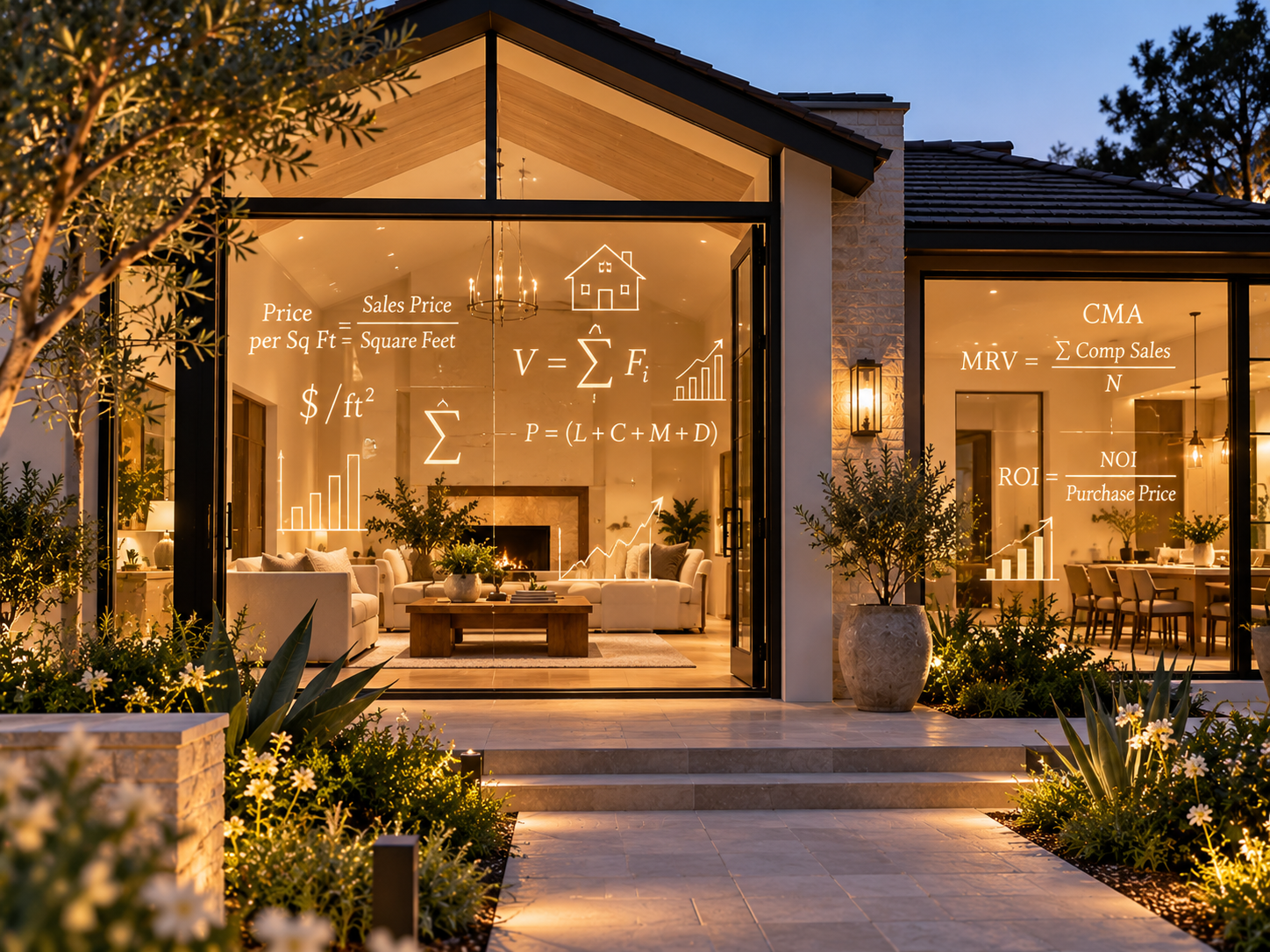
When it comes to determining what a home is worth, there are plenty of numbers to consider. Recent comparable sales, square footage, lot size, bedroom and bathroom counts, location, and current market conditions all play a role in establishing value.
But here's something many buyers and sellers don't realize: Real estate valuation is based on facts, but it isn't purely mathematical.
One of the most commonly misunderstood measurements is price per square foot. It's a useful tool for understanding the general price range of homes in a particular area, but it should never be used as the primary method for determining what a specific property is worth.
There are simply too many variables that make each home different. And beyond the physical characteristics of a property, there's another factor that can have a significant influence on what someone is willing to pay: emotion.
Understanding how these factors work together can help buyers make more informed decisions and sellers establish realistic expectations when pricing their homes.
Price Per Square Foot: A Useful Starting Point, Not a Pricing Formula
Price per square foot is calculated by dividing a home's sale price by its total living area. It's an easy way to compare properties and get a general sense of pricing within a neighborhood.
For example, if a 2,000-square-foot home sells for $1,400,000, its price per square foot is $700.
That number can be helpful when evaluating other properties nearby, but it doesn't tell the whole story.
Consider two homes in the same neighborhood, both measuring approximately 2,000 square feet. One sells for $1,400,000, while the other sells for $1,550,000.
Does that automatically mean the second home was overpriced?
Not necessarily.
Perhaps the second home has been extensively renovated, has a larger and more usable lot, offers better views, has a more desirable floor plan, or backs to open space. Maybe it has a pool, a recently remodeled kitchen, or a private outdoor entertaining area.
The homes may have similar square footage, but they aren't necessarily comparable in terms of overall value.
Price per square foot can help establish a ballpark range, but it cannot account for everything that makes one property more desirable than another.
What Actually Influences the Value of a Home?
A home's value is influenced by a combination of physical characteristics, location, condition, market conditions, and buyer demand. Some factors can have a substantial impact on value, while others may be less significant depending on the property and the market.
Here are some of the details that often matter more than square footage alone.
Location Within the Neighborhood
Even within the same community, location can make a meaningful difference.
A home backing to open space may be more desirable than a similar home backing to another property. A quiet cul-de-sac may appeal more than a home on a busy street. A property with unobstructed views may command a premium over one without them.
Other considerations include proximity to parks, schools, shopping, major roads, and neighborhood amenities.
In coastal communities such as Carmel Valley, Del Mar, Solana Beach, Encinitas, and Carlsbad, proximity to the ocean, views, and access to local amenities can also influence buyer demand.
Lot Size, Usability, and Privacy
Lot size is important, but the amount of usable outdoor space can be even more relevant.
Two properties may sit on similarly sized lots, yet one may offer a flat backyard, room for a pool, and space for entertaining, while the other has steep slopes, limited usable space, or significant privacy concerns.
Factors such as orientation, landscaping, neighboring properties, outdoor living areas, and the ability to expand can all influence desirability.
Floor Plan and Functionality
Square footage doesn't necessarily translate into usable living space.
A thoughtfully designed 1,900-square-foot home may feel more spacious and functional than a poorly configured 2,200-square-foot home.
Room placement, natural flow, storage, bedroom separation, ceiling height, natural light, and the relationship between indoor and outdoor spaces all contribute to how a home feels and functions.
Buyers often place considerable value on a floor plan that fits their lifestyle, even when another property offers more square footage.
Condition and Quality of Improvements
A home that has been extensively updated may command a different price than a comparable property requiring significant work.
However, not all improvements contribute equally to value.
A remodeled kitchen, updated bathrooms, new windows, modern HVAC system, or newer roof may make a home more appealing and reduce anticipated maintenance costs.
The quality of the work also matters. Professional renovations with desirable finishes and thoughtful design may have a greater impact than cosmetic updates completed simply to prepare a property for sale.
It's also important to recognize that the cost of improvements does not necessarily translate dollar for dollar into increased market value.
Views, Orientation, and Natural Light
Some property characteristics are difficult to quantify but can have a meaningful influence on buyer demand.
Views, natural light, privacy, and orientation are good examples.
A home with panoramic views, abundant natural light, and desirable outdoor exposure may be significantly more appealing than a similar-sized home without those features.
These characteristics are particularly relevant in coastal and hillside communities throughout North County San Diego.
Market Conditions and Comparable Sales
Even a beautifully maintained home in a desirable location is subject to current market conditions.
Interest rates, available inventory, buyer demand, seasonality, and the number of competing properties can all influence what buyers are willing to pay.
Recent comparable sales provide an important foundation for determining value, but it's essential to look beyond the final sale price.
Was the comparable property recently remodeled? Did it receive multiple offers? Did the seller provide credits? Was it sold under unusual circumstances? How long was it on the market?
A comparable sale is only useful when you understand how closely the property and circumstances resemble the home being evaluated.
The Role of Emotion: Why Buyers Don't Always Pay the Same Price
Here's where real estate valuation becomes particularly interesting.
Two buyers can walk through the exact same home, review the same comparable sales, and arrive at very different opinions about what the property is worth.
Why?
Because buyers don't purchase homes based solely on numbers. They also purchase based on how a home makes them feel.
Imagine two buyers considering the same property.
Buyer One falls in love with the home.
The layout is exactly what they've been looking for. They can picture their family gathering in the kitchen, entertaining friends in the backyard, and enjoying the neighborhood for years to come.
They've looked at several other properties, but this one feels different. They don't want to lose it.
Although the comparable sales suggest a certain value, they're willing to stretch beyond that number because the home checks so many boxes. They may be comfortable offering more than they originally planned because the emotional value of securing the property outweighs the difference in price.
Buyer Two likes the home, but doesn't feel particularly attached to it.
The property meets their needs. The location works, the layout is acceptable, and the price is reasonable. However, they don't feel that this is the one.
They approach the purchase more analytically, relying heavily on comparable sales, condition, and potential future expenses. If the asking price feels too high, they're comfortable making a lower offer or walking away.
Neither buyer is necessarily wrong. They're simply assigning different levels of personal value to the same property.
This is one reason market value and what an individual buyer is willing to pay are not always the same thing.
A home may have a supportable market value based on comparable sales, yet a particularly motivated buyer may be willing to pay more because the property offers something they haven't found elsewhere.
Conversely, a buyer who sees the property primarily as a financial decision may not be willing to pay that premium.
Why Emotion Can Influence the Final Sale Price
When multiple buyers compete for a property, emotion can become an important factor in the final sale price.
A buyer who has been searching for months may feel particularly motivated when they finally find a home that meets their needs. If another buyer is competing for the same property, the desire not to lose it can influence their offer.
This doesn't mean buyers should abandon logic or make decisions they cannot financially support. It simply means that the perceived value of a home can extend beyond its physical features and comparable sales.
There are also situations where emotion works in the opposite direction.
A buyer may walk into a home and immediately notice dated finishes, an awkward floor plan, or a lack of privacy. Even if the home is priced appropriately according to comparable sales, those characteristics may make it less appealing to that particular buyer.
The important distinction is that market value is informed by what buyers are willing to pay, but individual buyers don't all value the same property equally.
This is why the final sale price is the result of both market evidence and the decisions of the people participating in the transaction.
How Sellers Should Use This Information When Pricing a Home
For sellers, understanding the difference between price per square foot and actual market value is particularly important.
It's tempting to look at the highest-priced sale in the neighborhood, divide it by the square footage, and use that number to establish an asking price. But that approach can create unrealistic expectations.
A more meaningful pricing analysis considers:
- Recent sales of genuinely comparable properties.
- Differences in location, lot size, views, and privacy.
- The home's condition and quality of improvements.
- Floor plan, functionality, and overall appeal.
- Current competing listings and available inventory.
- Recent buyer activity and market conditions.
- Features that may make the property particularly desirable to its likely buyer pool.
Pricing also involves strategy.
An asking price needs to attract attention from qualified buyers while reflecting the property's actual characteristics and current market conditions. Pricing too aggressively can discourage buyers from scheduling a showing, while thoughtful pricing can generate interest and potentially encourage competition.
The goal isn't simply to find the highest price per square foot in the neighborhood. It's to understand how the property compares with other available and recently sold homes, then position it appropriately in the market.
How Buyers Can Balance Emotion With Logic
For buyers, emotion is not necessarily a bad thing. After all, a home is more than an investment. It's where you live, spend time with family, entertain, and create memories.
If you find a property that genuinely feels right, it's reasonable to assign value to features that matter to you personally.
However, it's important to understand the difference between what a home is worth in the market and what it is worth to you.
Before making an offer, consider:
- How does the asking price compare with recent sales?
- Are there meaningful differences between this property and the comparables?
- Does the home have features that are difficult to find elsewhere?
- Are you comfortable with the purchase price and monthly expenses?
- If you offer more than the comparable sales suggest, are you comfortable with that decision?
- Would you still feel good about the purchase if the market value did not immediately support your purchase price?
A home that checks every box may be worth stretching for, provided the decision is intentional and financially sound.
The goal is not to remove emotion from the process. It's to make sure emotion doesn't replace informed decision-making.
Real Estate Pricing Is Both an Art and a Science
There is no single formula that accurately determines the value of every home.
Comparable sales, price per square foot, property characteristics, and market conditions provide the factual foundation for a pricing analysis. But interpreting those facts requires experience, perspective, and an understanding of what buyers value.
And sometimes, the most important factor isn't something that can be measured in square feet or calculated on a spreadsheet.
It's how a buyer feels when they walk through the front door.
For sellers, understanding what makes a property desirable to buyers can help establish a thoughtful pricing strategy. For buyers, recognizing the influence of emotion can help balance the excitement of finding the right home with the realities of the market.
Chuck Buss & Kylie Reiter combine local market knowledge, comparable sales analysis, and years of experience in North County Coastal San Diego to help buyers and sellers make informed real estate decisions.
Whether you're preparing to sell or searching for your next home, understanding what truly drives value is one of the most important steps in the process.
Check out this article next